
Missing Pickguards... or are they Scratchplates?
Even a small mystery needs an answer.

Many years ago, as my fledgling Beatles library began to grow, it happened more often that a “newly discovered” archive of Beatles photographs appeared on bookshelves. As luck would have it, more photographers were opening up collections of their old unused (and unsold) photographs of The Beatles from the world tours in 1965 and 1966.
When it came to photos of The Beatles on tour, many of the best photos found were of the blockbuster 1964 North American Tour in which they played 32 shows in 24 cities over 31 days. The Beatles in 1964 were still a novelty to the press and there was a lot of coverage for the shows and press conferences. By 1966, newspaper articles were still written but publishing photos of them performing became less frequent.
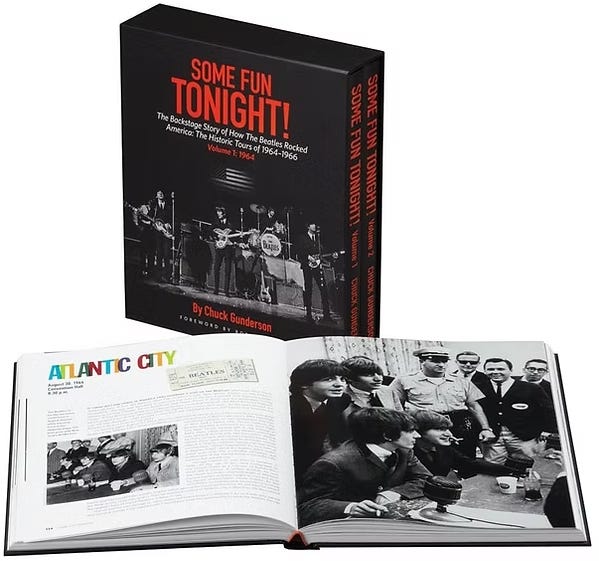
Some of the better photo books were from the archives of photographers The Beatles befriended and trusted such as Robert Freeman and Bob Bonis. The photographs in their books are nothing short of spectacular. Many other photos were hidden away in various archives and only available to researchers like Chuck Gunderson, when he was researching and writing his wonderfully detailed and illustrated 2-volume book, Some Fun Tonight (The Backstage Story of How The Beatles Rocked America: The Historic Tours of 1964-1966).
I was always drawn to photos of The Beatles performing onstage. These always had a magical quality to them, as far as I was concerned. Like most fans, the more common live photos I saw were usually some stock photo from the first US tour or from Shea Stadium in 1965 or even the first appearance on the Ed Sullivan Show. My dad frequently took my brother and to a used bookstore in town and during one visit, he bought a book for my brother called, The Beatles Illustrated Lyrics. It was not the larger volumes that feature some really unique and colorful artwork inspired by Beatles songs. This one was a small paperback in which the center pages featured some very different black and white photos that I had never seen before. A number of these were from 1966 and included the 1966 New Musical Express Pollwinners Concert and the 1966 Shea Stadium show. In those photos, John and George were not playing the Rickenbacker and Gretsch guitars that seemed to be their tour workhorses. I also noticed Paul’s Hofner bass guitar look different in some photos in that the pickguard had been removed.


As more photos and more books became available, I learned a little about the guitars they used and when they obtained them. Now, thanks to books like Andy Babiuk’s Beatles Gear, one doesn’t have to consult many sources for such information. But I also found that both Paul and George had their pickguards removed from their guitars in the middle of the the last North American tour.
Photographs show The Beatles usually brought a small arsenal of guitars with them for their tours. The last tour was no different and the breakdown for the three guitarists was like this:
John Lennon - 1965 Epiphone Casino with his (actually George’s) 1962 Gibson J160-E (acoustic) as his backup.
Paul McCartney - 1963 Hofner Bass with his 1964 Rickenbacker 4001S as his backup.
George Harrison - 1965 Epiphone Casino, 1965 Rickenbacker 360/12, and his 1964 Gibson SG Standard as his backup.

At the beginning of the ‘66 World Tour, photos from the June 24, 1966 Munich shows have all the guitars were all intact with the pickguards in place.

By the time they reached the end of the road (literally) at San Francisco’s Candlestick Park on August 29, 1966, some changes to the guitars had taken place.

I began to dig deeper where and when I could.
After reviewing some online photos from a Japanese (and now-defunct) Beatles photo archive website, I found that the pickguard on Paul’s Hofner bass could be seen when The Beatles performed their sole concert in Washington DC on August 15, 1966. In photos from taken the following day at the Philadelphia show, it can be seen that the pickguard was removed from the bass guitar and has never been replaced.
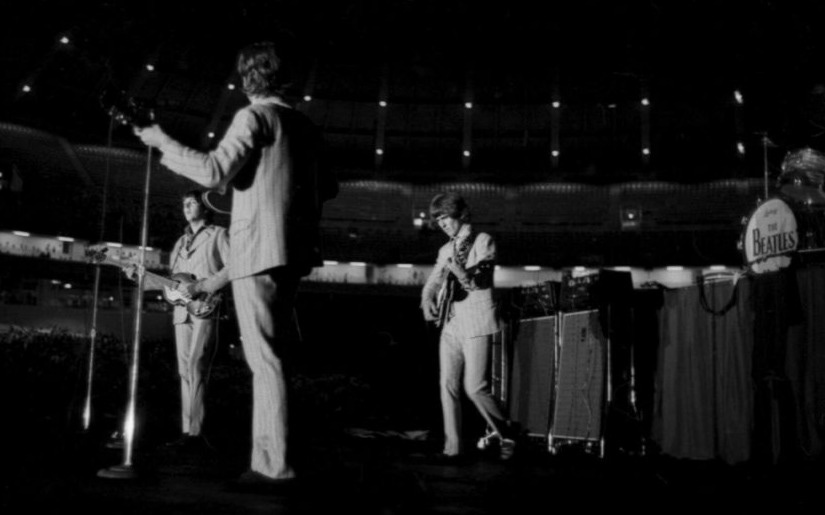
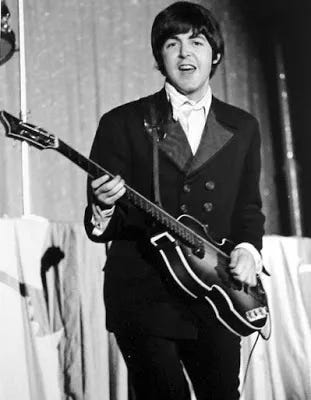
An old website called “The Beatles Rarity” had a feature where fans could ask “Happy Nat” their questions about obscure Beatles minutiae. Someone asked him about Paul’s pickguard and possible reasons for its removal. This was his response:
“First off, concerning the construction, I know that these floating pick guards are suspended over the body rather poorly by means of a couple of thick wire pins which attach at both the bridge and the heel of the neck. It may have become a bother to keep secure. Another possibility is that it may have been more to do with Paul’s preference on it’s appearance. Although I can’t say I’ve heard specifically from Paul on this but I do know that many players of this particular model do prefer the look of it without the pick guard.”
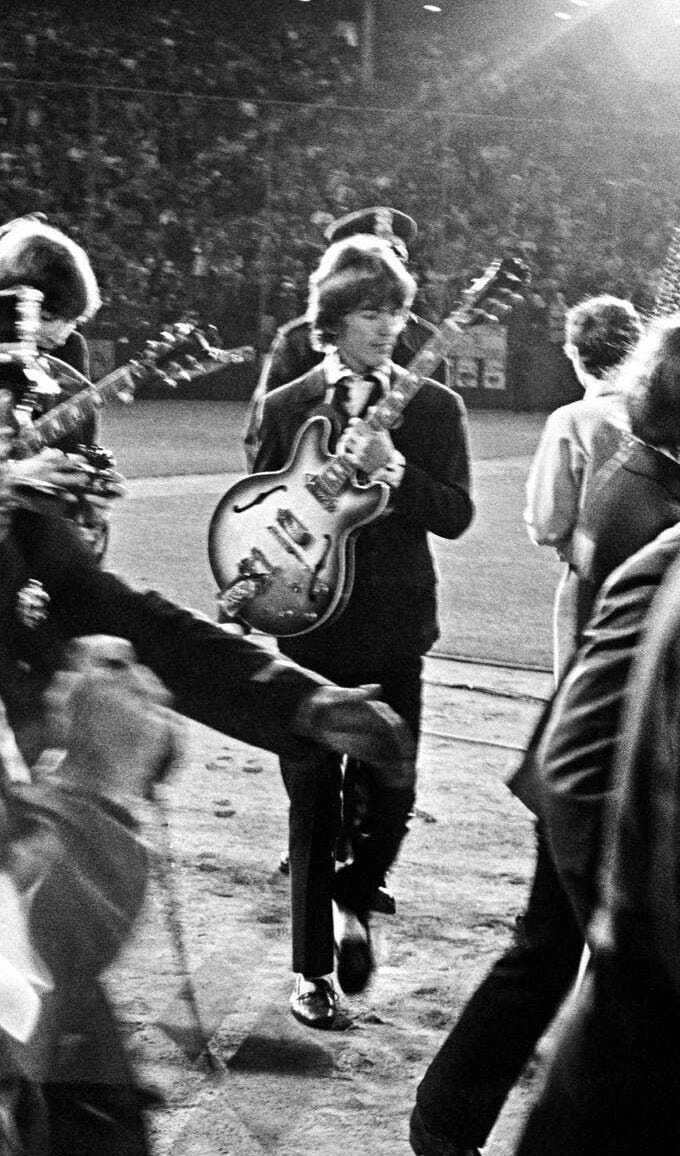
Photo evidence of when George Harrison removed the pickguard of his Epiphone Casino proved to be a lot more elusive.
On August 23, 1966, The Beatles returned to Shea Stadium, where a year previously, they had set the world record for the largest concert. As they had done in 1965, they performed a single show on a stage set up near second base of the New York Mets’ baseball diamond. Photos show the pickguard is intact on George’s Casino.
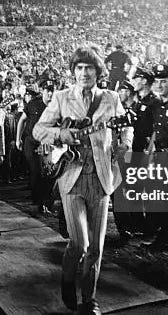
They next played two shows at the Seattle Center Coliseum on August 25, 1966. Photos from the evening show are more plentiful and show that George’s pickguard had been removed. The ones from afternoon show were nowhere to be found online.
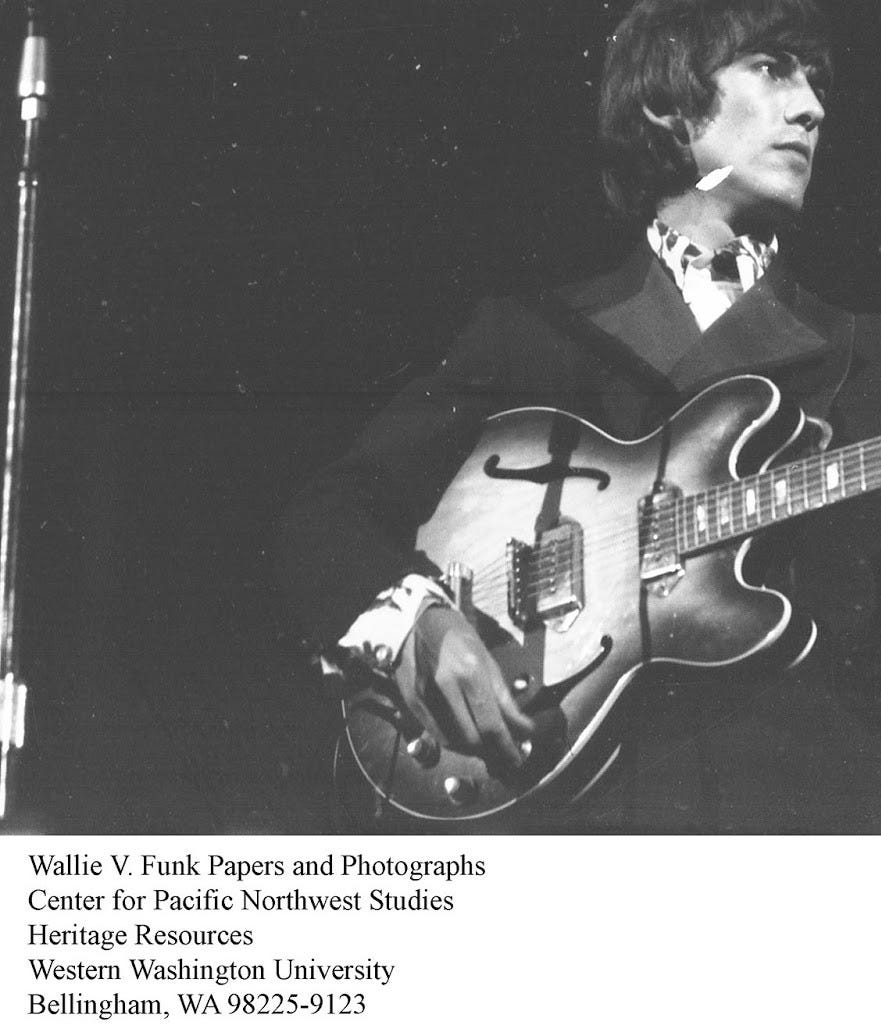
Back in November 2012, I was able to view some microfilm of the Seattle Post-Intelligencer daily newspaper. In it, I found this photo from the afternoon show that proved to be inconclusive. I took a photo with my cell phone (not a smartphone) and still had it saved.
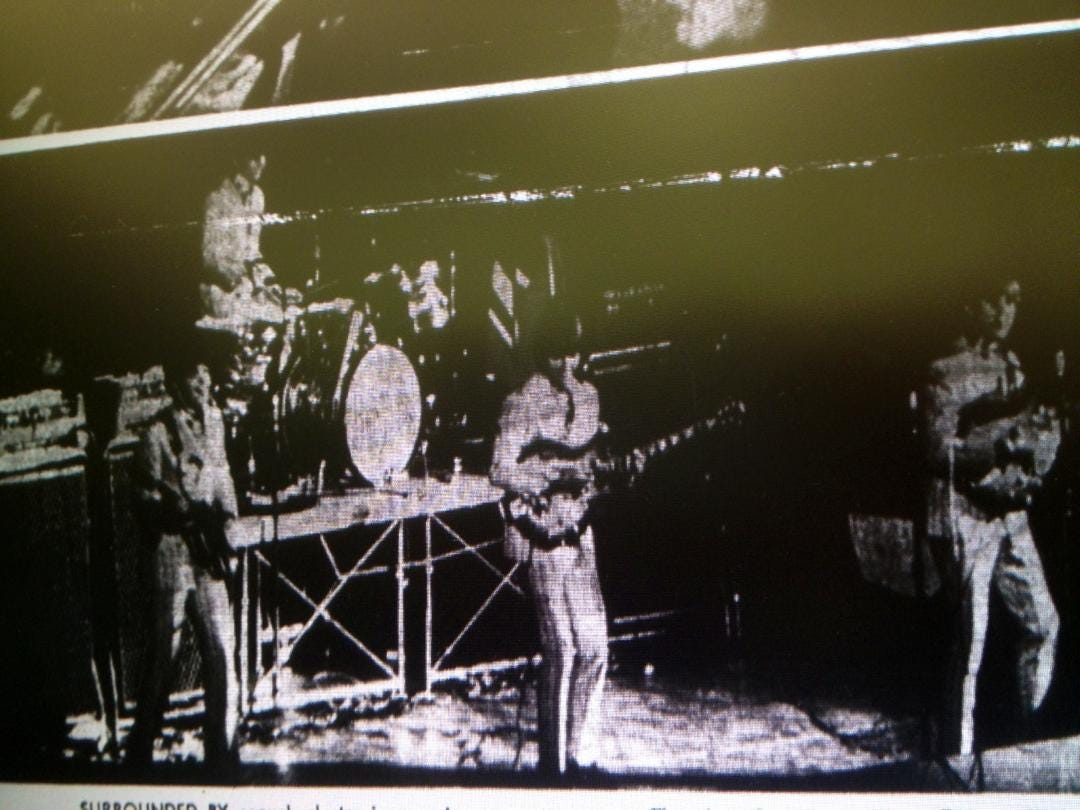
It does show The Beatles wore light colored stage clothes as opposed to the dark suits they wore for the evening show. George is seen in the middle, but it is difficult to determine the state of the guitar.
A few months later, I had sent an email to Chuck Gunderson about his upcoming book, which I mentioned earlier, and told him about my lack of findings. He was kind enough to reply and I found he was doing some last minute research and was also looking for some photos from the Seattle shows for the book. Finally, in a September 5, 2013 email, he responded with some good news.
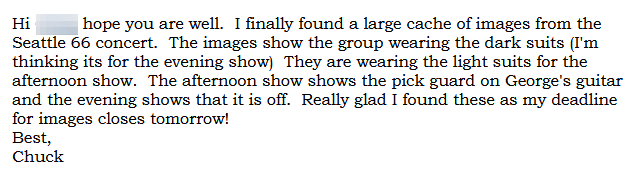
So Chuck had found photographic evidence that George’s pickguard was removed sometime between the afternoon and evening Seattle shows in 1966 and was nice enough to share that with me. He even included his findings in his book within a caption of a photo on page 279 of Volume 2. The mystery of the “when” seemed to have been solved.
I have read in some websites that reasons for removing pickguards range from trying to achieve a more pleasing look, trying to enhance the sound of the guitar or avoiding a buzzing sound that may develop from a loosely installed or cracked pickguard.
Fast forward 11 years to 2024 when this TV station footage of the afternoon show made its debut onto YouTube:
In all fairness to Chuck, I have to say that in this footage of the afternoon show in Seattle, it certainly appears that the pickguard had been already been removed from George’s guitar. It is clearly evident that John’s nearly-identical Casino still has the pickguard attached (it was removed later).
I did not want to leave out John, so for the sake of completeness, here is a photo of George playing John’s Epiphone Casino during rehearsals for the “Our World” broadcasts on June 25, 1967. Although the pickguard had been removed, the mounting bracket can still be seen across the lower sound hole by his left leg.
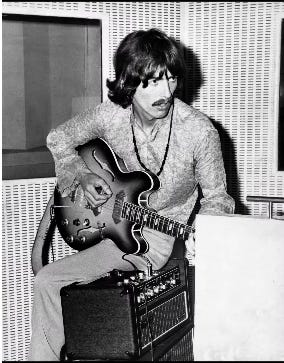
Funny enough, Paul later removed the pickguard from his Epiphone Casino, as well, but he did keep the sunburst finish.
To be continued…?
Talk to you soon,
Jack Aubrey